
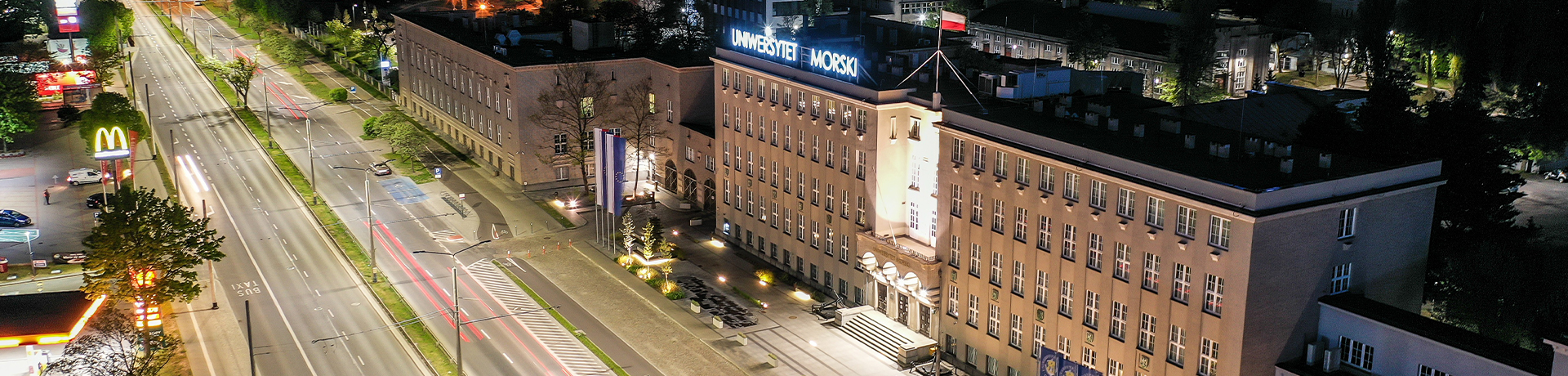
Inaugural Address by the Rector of Gdynia Maritime University for the 2024/2025 Academic Year
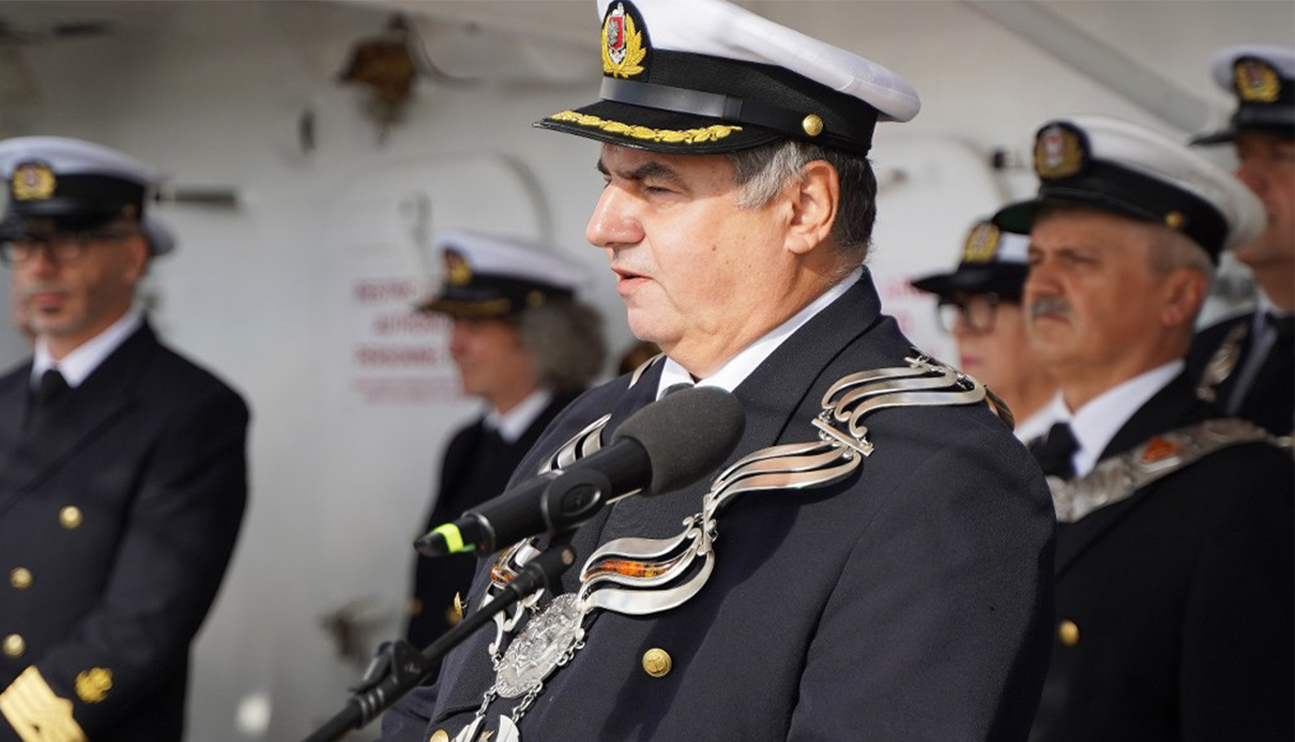
Inaugural Address of HM The Rector of
Gdynia Maritime University,
Professor Adam Weintrit
Ladies and Gentlemen,
The inauguration of a new academic year is an important moment in the life of every university. This holds true for us as well. Today is a grand celebration at Gdynia Maritime University – a celebration of our entire academic community. It is, above all, a celebration for students, particularly our first-year students, many of whom are accompanied today by their loved ones: parents, guardians, siblings, and friends.
We have gathered here in great numbers on the Gdynia quayside to mark this special day – for today, Saturday 5 October, in the presence of the highest authorities of Gdynia Maritime University, the Senate and the University Council, the Deans, and the wider academic community, along with invited guests, representatives of state, local government, and economic life, and with Dar Młodzieży in attendance – our training ship and the best-known and most recognisable ambassador of the Republic of Poland – the matriculation of first-year students and doctoral candidates will take place, including the swearing of the solemn oath on the banner of Gdynia Maritime University.
I must admit that this year’s inauguration of the academic year is especially significant for me. I am beginning a new term as Rector of Gdynia Maritime University for the years 2024-2028. On the one hand, this fills me with pride and satisfaction; on the other, it presents a great challenge and a significant responsibility to make our University an even better research, training and educational institution, as well as an attractive place to work and, above all, to study – with a primary focus on your future, dear students, and on creating conditions that will guarantee your development.
Dear First-Year Students,
This morning, a thought occurred to me – I realised that if you apply yourselves, if everything goes as planned, and if nothing interferes with your pursuit of the goal of completing, at the proper time, the studies you are starting today in one of the many specialisations we offer, you may find my signature on your diploma – whether it be your first engineering or bachelor’s diploma. You should be able to achieve this in four years. However, should there be a slight delay, your diploma will bear the signature of my successor.
I apologise for this aside. It simply dawned on me that you are the last year group whom I may have the opportunity to graduate.
Dear Students, Ladies and Gentlemen,
Gdynia Maritime University is an institution with over a century of tradition. Its mission since its inception has been to educate highly qualified personnel for the maritime economy. Over the years, the development of the University has enabled the creation of an original research centre and expert base that actively impacts the socio-economic environment, conducts scientific research of the highest calibre, and supports the creation of an economy based on innovation, particularly in the wider maritime sector.
In response to the needs of our country and region, Gdynia Maritime University fosters among its students, doctoral candidates and staff attitudes characterised by entrepreneurship and respect for the principles of sustainable development, instilling a sense of responsibility for actions taken in the context of the economy, economics, and the natural environment. The University also serves as an advisory and opinion-forming body in matters concerning the maritime economy and the training of professionals for its needs.
Historia magistra vitae est. History is the teacher of life.
The history of our University dates back to 1920:
• when Poland regained access to the sea and began laying the solid foundations for a maritime economy,
• when, in February, General Józef Haller performed the symbolic act of Poland’s marriage to the sea in Puck,
• when, on 17 June, the state authorities made the decision to establish a Maritime School, choosing Tczew as its location.
Teaching activities, however, could only commence after the end of the Polish–Soviet War, in which many of our future students took part. The ceremonial start of the school year finally took place on 8 December 1920. In memory of this event, we celebrate University Celebration Day every year on this date.
The first students of our University were therefore young people who had only just returned from war. Not long afterwards, as graduates of our institution, they set out for yet another war – this time against the German occupier – writing a noble chapter in our nation’s history by participating in convoys, patrols, battles, and both major and minor military operations, including the Allied landings in Normandy.
The sea became a place of fierce battles, a place of victories, but also, for many of our the Maritime School’s heroes, a place where they lost their health and their lives. Today, the sea is above all our window to the world – more widely open than ever before – and access to the Baltic Sea has a significant impact on the development of our country’s economy, not least thanks to the emergence of new industries and technologies, including, more recently, the offshore sector, in which our University plays a key role.
Dear Students,
Starting today, you too can have an impact on the history being written at our University, as you are joining an academic community rich in maritime traditions and proud accomplishments.
I wish for your time at Gdynia Maritime University to be both inspiring and unforgettable. Do not be afraid to ask questions. Exchange ideas, share your observations, engage in discussion – not only among yourselves but, above all, with your professors and lecturers during classes, lectures, and consultations. It is often in such interactions that innovative ideas and unconventional solutions are born. Please remain open-minded and curious about the world; boldly take advantage of everything our University has to offer. You are becoming part of an institution where freedom of thought, speech, belief, and opinion prevails.
The core values of Gdynia Maritime University are: truth and integrity in science and education, a strong link between the educational process and the needs of the economic environment, innovation, and openness to the needs of individuals and the world around us. The University is guided by universal human values: human dignity and freedom, social equality, solidarity, and tolerance – all of which foster academic development and a culture of cooperation.
Generations of maritime professionals educated at our Alma Mater form primarily the officer corps of the merchant fleet. Yet among our graduates are not only master mariners, chief engineers, superintendents, electricians, electronics engineers, automation specialists, radio officers, chief stewards and pursers, but also politicians, ministers, diplomats, ambassadors, consuls, maritime attachés, parliamentarians – senators and members of parliament – voivodes, local government officials, entrepreneurs, business executives, owners, directors and heads of shipping companies, maritime economy enterprises, ports, shipyards and maritime administration, pilots, and renowned sailors. There are also journalists, artists, maritime authors, and outstanding academics and scientists, of whom we should be proud. One thing is certain – whoever comes here is certainly no ordinary person.
Make the most of the opportunities offered to you by our Faculties: Electrical Engineering, Marine Engineering, Navigation, and Management and Quality Science – and soon the Faculty of Computer Science, which I established this year by decision of the GMU Senate and which we are now actively developing.
You will take part not only in interesting theoretical classes and lectures, but also in hands-on practical activities. The knowledge you gain will be continually tested and applied in workshops, laboratories, simulator training, and training on board the University’s vessels – especially Dar Młodzieży, from which I am addressing you today – the showpiece of our University, of Poland, and of Gdynia, known around the world as the White Frigate.
Exactly one year ago, on World Maritime Day, Dar Młodzieży crossed the Equator in the Atlantic Ocean. This was a symbolic tribute to the 100th anniversary of the first Polish-flagged vessel crossing the Equator – a milestone first achieved in 1923 by our former training ship Lwów.
Our students also undertake practical training aboard Horyzont II – our training and research vessel, which plays a key role in Polish polar projects and is an integral part of Poland’s presence in the Arctic.
The third ship operated by Gdynia Maritime University is IMOR, a state-of-the-art floating marine laboratory equipped with next-generation measuring instruments. It is used primarily for research conducted by the GMU Maritime Institute.
The University also includes the Centre for Sailing and Water Sports, which offers training on sailing yachts, a motor yacht, and high-speed RIB boats. Students take part in courses and training on these vessels as well. Additionally, the Ship Handling Research and Training Centre in Iława offers specialist courses to enhance ship-handling skills, primarily for sea captains and marine pilots.
The University is currently working intensively on the development of a financing model for the construction of the successor to Dar Młodzieży. It will soon be time for this frigate, now more than 40 years old, to be replaced by another training ship, the fourth in line after Lwów, Dar Pomorza, moored nearby, and Dar Młodzieży. Not long ago, in September, in the interests of maintaining high standards of education of maritime personnel in Poland, University representatives met with representatives of national, local-government and city authorities to discuss the need to build a successor to Dar Młodzieży. We were visited by senators, members of the Senate Foreign Affairs Committee, including the Committee’s Chair, Senator Grzegorz Schetyna, and the Speaker of the Senate, Małgorzata Kidawa-Błońska, as well as representatives of the Pomeranian Parliamentary Group, led by MP Agnieszka Pomaska.
Dear Students,
It is often said that a healthy mind resides in a healthy body. Physical fitness is just as important as the skills and knowledge you will acquire while studying at our University. You now have access to a newly opened, modern sports hall located in the University’s Sports and Recreation Centre – a facility inaugurated in May of this year. It is yet another high-standard, modern sports venue in the Tri-City area.
This building marks the first stage in the construction of a planned academic and sports complex on this site. It is my ambition to see a new, modern student residence built on the University campus on Morska Street during this term of office, along with the optimal development of the surrounding area.
Let me remind you that the five-storey Sports and Recreation Centre of GMU was built on the site of the former sports hall, which was demolished in 2020. The centre is not only used for physical education classes. It also houses a gym with cardio and fitness zones, conference rooms, an accommodation area, and a spacious underground car park.
Dear Students,
At the University, there are over a dozen student scientific societies, where research-minded students can pursue their academic passions. I warmly encourage you to explore these opportunities.
Studying at Gdynia Maritime University is also a time for developing your extracurricular interests, including sports. This is strongly supported by the rich offering of sports clubs active at the University.
I also encourage you to take advantage of and get involved in many other activities taking place within our University. One such opportunity is joining our Gdynia Maritime University Academic Choir, which has been active for over twenty years under the direction of Dr Karol Hilla. Our University Choir is the recipient of numerous awards from national and international competitions and festivals, including in Spain, Romania, and Lithuania. It performs successfully on major stages in Poland, appearing alongside stars of the Polish music scene, as well as world-renowned artists such as Andrea Bocelli.
At this point, I must also mention that, as a uniformed institution honouring maritime ceremonial traditions, we have our own Guard of Honour – an elite symbol of the University, dedicated to preserving Poland’s maritime heritage. The Guard is responsible for organising, securing, and providing the ceremonial setting for University events, as well as participating in other official functions.
Dear Students,
Your time at our University is also a time during which many of you will likely form lasting friendships. Such bonds will be fostered by events organised by your senior peers, such as the Student Ball or the Gdynia-based Delfinalia festival, which returned last year following a break due to the pandemic.
You will also find places to relax and recharge between classes in the Student Zones located in all University buildings. This spring, a Student Zone was opened in the University’s main building, equipped with a pool table, a PlayStation 5 console, games, and chess. Additional Student Zones can be found in the Faculties of Marine Engineering and Navigation, as well as in the Karol Olgierd Borchardt Main Library.
I hope that another excellent meeting spot for you will be the now iconic student club Bukszpryt, which regularly hosts cultural and entertainment events. The next event takes place this very evening – organised by the Student Parliament and is open to all students beginning their studies at our University.
Dear Students, Ladies and Gentlemen,
Bukszpryt is not the only place for socialising and community building within our academic family. A wonderful opportunity to come together is the University’s annual Sports Day, which traditionally ends with a shared gathering of students and staff on campus. Competitions in water sports are customarily held at the Stella Maris Centre in Kashubia.
Another project worth mentioning, one that combines sporting, recreational, and educational purposes, including navigation training, is the Green Control Point developed by the University in cooperation with the Gdańsk Forest District and opened in October last year. The facility is located in the Tri-City Landscape Park, between Grabówek, Leszczynki, Działki Leśne, Witomino, Demptowo and Chwarzno. The project was conceived and designed by Dr Piotr Kopacz from the Faculty of Navigation.
Dear Doctoral Candidates,
You are about to begin classes at our Doctoral School, marking the start of an extremely intensive period of academic work. I am confident that your research will, in the coming years, lead to the completion of a compelling doctoral dissertation, and that its successful defence will mark the award of your doctoral degree.
Regardless of the path you choose afterwards – whether you remain at the University or pursue another direction – please remember that you, young researchers, are the ones charting new paths in the world of science. This is both a privilege and a responsibility. May the results of your work always serve the public good and contribute to the advancement of our economy.
Dear Doctoral Candidates, Ladies and Gentlemen,
Let me remind you that the Doctoral School of Gdynia Maritime University provides education in four disciplines:
- management and quality sciences;
- automation, electronics, electrical engineering and space technologies;
- civil engineering, geodesy and transport;
- Earth and environmental sciences.
The mission of the Doctoral School of Gdynia Maritime University is to provide interdisciplinary preparation for doctoral candidates for scientific, teaching and expert work for the benefit of the academic, social and economic environment.
Dear Students,
Your peers achieve numerous scientific and sports successes every year. Allow me to offer my sincere congratulations and best wishes for further achievements, and to mention at least some of them, starting with academic accomplishments.
I congratulate Łukasz Stolzmann, a student of the Faculty of Navigation, who was among the winners of the 6th edition of the competition for the Minister of Development and Technology’s Award for the best thesis and innovative solutions in the field of geoinformation for 2023.
I am also delighted with the recognition of your colleagues from the Faculty of Management and Quality Science and the Faculty of Navigation, who this year received Marshal of the Pomeranian Voivodeship Scholarships during this year’s Offshore Wind fair.
We can also be proud of the sporting achievements of our students.
I congratulate Aleksander Cirocki, a student of the Faculty of Electrical Engineering, who, representing our University this year, won gold in his group in Classic Powerlifting.
I am also pleased with the Academic Polish Cup in road cycling, which was won by Marta Kwiatkowska, a student of the Faculty of Management and Quality Science, who finished 3rd in the women’s Open category in the spring of this year.
I am consistently proud of the successes of our sailors. Especially their latest success in August of this year – the gold medal at the Polish Championships in the Omega Sport class, the Baltic Cup, and the leading position in the Polish Cup, won by the POL-654 crew consisting of Dr Jędrzej Charłampowicz, Bartosz Sadowski, and Bartosz Mach.
Dar Młodzieży also continues to achieve sailing successes almost annually, participating in the prestigious Tall Ships Races. This is undoubtedly a reason for pride and joy. It is also worth noting that alongside the training our students undertake on the ship, the Tall Ships Races will be an excellent opportunity for you, young people, to integrate with the crews of other tall ships participating in these regatta events.
May those of you who earn accolades for your hard work and perseverance in pursuing your goals serve as an example worth following for your fellow students. Please, compete with each other, inspire one another, but most importantly, support each other.
Dear Students, Ladies and Gentlemen,
Our University works closely with entities from the business environment, being a valued advisory voice and preparing expertise and opinions in areas related to the maritime economy. This is assisted by our University’s Technology Transfer Office, established two years ago.
Today, the whole world, including Poland, is facing an energy crisis, and an alternative to energy derived from fossil resources is required. In response to this need, Gdynia Maritime University is particularly supporting the development of the offshore wind energy sector.
Our efforts in this area are recognised by the industry, as evidenced by the Golden Anchor Award in the Offshore category for ‘education and research for offshore wind energy’ awarded to the University by Baltexpo in October last year.
Furthermore, the construction and opening of the GMU Centre for the Offshore Industry in Gdańsk in February this year undoubtedly demonstrates that Gdynia Maritime University is already one of the leaders in the Polish offshore market, especially in environmental research for offshore wind energy. Our mission is to create a ‘Polish Offshore Valley’, and the GMU Centre for the Offshore Industry fulfils all the conditions for this. This is where the GMU Maritime Institute and the GMU Offshore Wind Energy Centre are based. Speaking of the GMU Centre for the Offshore Industry, it is worth mentioning its excellent location. The facility is located at Roberta de Plelo Street in Gdańsk, right next to the Wisłoujście Fortress, and has direct access to a 500-metre-long quay, of which 200 metres are handling quays that allow for the docking and servicing of research, training, and service vessels, both for the University and its contractors. The GMU Centre for the Offshore Industry also houses state-of-the-art accredited geotechnical, environmental, and electronic laboratories tailored to the requirements of the modern maritime economy.
The GMU Centre for the Offshore Industry is also home to an excellent specialised team of 120 employees of the GMU Maritime Institute, who participate daily in comprehensive, specialised research and development work for the innovative maritime industry.
The Centre has been operating for half a year and was ceremoniously opened on 29 February of this year. It undoubtedly supports the further development of our University’s potential, including the establishment of new cooperation agreements, both domestic and international.
At this point, I would also like to draw attention to our newest academic programmes, which include courses related to the offshore industry.
Just over two weeks ago, here, in the Captain’s Salon on board Dar Młodzieży, a ceremony was held for the award of diplomas to the graduates of the first edition of our four-semester Executive Offshore Wind MBA programme, which we successfully run in English in cooperation with Hochschule Bremerhaven – University of Applied Sciences, Germany, and Business Academy SouthWest, Denmark. I mention this consciously, especially in the context of the recent Collegium Humanum scandal, to emphasise that MBA studies can be conducted honestly, properly, and in compliance with all standards.
We also successfully run further editions of postgraduate programmes related to the offshore sector, such as ‘Risk Management in the Offshore Extraction and Offshore Wind Industries’ at the Faculty of Navigation, as well as ‘Cybersecurity in the Maritime Industry’.
Offshore-related programmes are also offered at bachelor’s and master’s levels at all of our Faculties.
Dear Students, Ladies and Gentlemen,
Gdynia Maritime University is constantly developing. In June of this year, during a meeting of the University Senate, I asked the Senators to give a positive opinion on the creation of a new Faculty at the University, the Faculty of Computer Science. The Senators supported my proposal. As of September of this year, our University has had five Faculties. However, the Dean of the Faculty of Computer Science faces a difficult task. He must build a team and, above all, create an attractive offer of degree programmes for students. I am confident that this is the right direction for the development of our University, and next year we will also welcome first-year students of the Faculty of Computer Science at Gdynia Maritime University. Topics such as IT technologies, cybersecurity, artificial intelligence, and autonomous vehicles, including MASS, Maritime Autonomous Surface Ships, are the future and challenges that we should already be preparing to face.
I would also like to briefly mention that the organisational structure of the University has slightly changed. We have created several new departments and units at several Faculties.
Ladies and Gentlemen, Dear Students,
The academic staff at our University, our lecturers, are world-class experts, valued for their academic achievements both here in Poland and around the world.
For their outstanding achievements on behalf of the maritime economy, achievements in science and teaching, implementation and the popularisation of Polish scientific thought around the world, this year, the following individuals were honoured with state decorations:
- with the Commander’s Cross of the Order of Polonia Restituta – Professor Janusz Mindykowski
and
- with the Officer’s Cross of the Order of Polonia Restituta – Professor Lech Murawski.
Also receiving recognition for their outstanding scientific achievements were staff members of the Faculty of Electrical Engineering:
- an Individual Award of the Minister of Infrastructure for career achievements to date was awarded to Professor Piotr Gnaciński,
and an award for achievements in science was presented to
- the research team led by Professor Krzysztof Górecki.
Another one of our successes is the inclusion of our staff in not one but two lists of Stanford University’s World’s Top 2% Scientists 2024. Included on the first list, which takes into account the scientific achievements of researchers throughout their scientific careers, are six Gdynia Maritime University scientists:
• Professor Agnieszka Lazarowska, Faculty of Electrical Engineering, currently Faculty of Computer Science,
• Professor Andrzej Stateczny, Faculty of Navigation,
• Professor Tomasz Tarasiuk, Faculty of Electrical Engineering,
• Professor Krzysztof Górecki, Faculty of Electrical Engineering,
• Professor Piotr Gnaciński, Faculty of Electrical Engineering,
• Professor Janusz Zarębski, Faculty of Electrical Engineering.
On the second list, which takes into account only scientific achievements in 2023, six GMU scientists were included:
• Professor Agnieszka Lazarowska, Faculty of Electrical Engineering, currently Faculty of Computer Science,
• Dr Krzysztof Wróbel, Faculty of Navigation,
• Dr Mariusz Specht, Faculty of Navigation,
• Dr Mateusz Gil, Faculty of Navigation,
• Professor Andrzej Stateczny, Faculty of Navigation,
• Professor Krzysztof Górecki, Faculty of Electrical Engineering.
Members of our staff have also once again become members of Scientific Committees of the Polish Academy of Sciences for the years 2024-2028:
Committee on Electronics and Telecommunications of the Polish Academy of Sciences
• Professor Krzysztof Górecki
• Professor Janusz Zarębski
Transport Committee of the Polish Academy of Sciences
• Professor Adam Weintrit
Committee on Metrology and Scientific Instrumentation of the Polish Academy of Sciences
• Professor Kalina Detka
• Professor Krzysztof Górecki
• Professor Agata Skwarek
Committee on Food and Nutrition Sciences of the Polish Academy of Sciences
• Professor Piotr Przybyłowski
Committee on Geodesy of the Polish Academy of Sciences
• Professor Andrzej Stateczny
• Professor Adam Weintrit
Also gaining recognition in February of this year was the Director of the GMU Maritime Institute, Professor Krzysztof Czaplewski, who was appointed as a member of the advisory team for the evaluation of applications for scholarships of the minister responsible for higher education and science for students and outstanding young scientists.
An important distinction, the Professor Romuald Kolman Individual Award, was awarded to Professor Piotr Przybyłowski by the Chapter of the Pomeranian Quality Award Competition this spring, for his work in promoting the concept of pro-quality management in the Pomeranian region.
Undoubtedly, all of these achievements bring us, the academic community, a great deal of pride.
Dear Students,
I trust that gaining knowledge from such a highly qualified academic staff will not only be an invaluable experience for you but, above all, an opportunity for your academic development.
Ladies and Gentlemen,
When speaking about individuals who have contributed to the development of science, culture, the economy, maritime education, or social life, it would be remiss of me not to mention two doctors honoris causa of the University, who were awarded this distinguished title last academic year.
This autumn, on 6 October 2023, one of the highest honours in the academic world – the title of doctor honoris causa of Gdynia Maritime University – was conferred, as the first international representative from the world of science, on Professor Hans Rummel from Hochschule Bremerhaven – University of Applied Sciences, a distinguished specialist in teaching Maritime English in an international context.
This spring, on 21 March 2024, Professor Bradford Parkinson from Stanford University in California, widely regarded as the father of GPS, was awarded the honorary title of doctor honoris causa of Gdynia Maritime University.
Dear Students, Ladies and Gentlemen,
It is no coincidence that I have mentioned the names of two distinguished scholars from beyond our borders. Gdynia Maritime University is permanently engaged in cooperation with institutions abroad, particularly with maritime universities within the framework of the International Association of Maritime Universities, IAMU, of which our University is a member and which I have the honour of chairing.
Our one hundred years of activity have been a constant, tireless journey ever upwards, full of challenges and determination, from the Maritime School to the State Maritime School, the Higher Maritime School, the Maritime Academy, and finally, Gdynia Maritime University. This enormous effort and progress have been recognised and acknowledged globally. Today, we lead an elite association of maritime universities worldwide. Our voice is heard and considered, which allows us to influence global maritime policy.
Next week, five staff members and six students from our University will travel to the United States, where I will preside over the IAMU Annual General Assembly at Massachusetts Maritime Academy, this year’s host institution. During the Assembly, we will formally welcome the Portuguese maritime university named after Prince Henry the Navigator into the Association. It was this very Prince Henry who, in the 15th century, founded Europe’s oldest maritime school, whose graduates played a key role in some of history’s most remarkable geographical discoveries. These include Bartolomeu Dias, Vasco da Gama, and Pedro Álvares Cabral.
It is worth emphasising that, five centuries later, it is we who will now be introducing the Portuguese institution to the global maritime arena.
Our active involvement in IAMU, as well as in the International Maritime Organization, IMO, a UN agency, and other international bodies, demonstrates that at Gdynia Maritime University, tradition meets progress. As a University, we are not only open to innovation and change in science, training, and education – we are actively involved in generating these changes. By engaging in joint research projects, participating in conferences, seminars, committees, subcommittees, and working groups, we are shaping global trends and helping to establish international standards.
Just last week, at the invitation of the Secretary-General of the International Maritime Organization, I took part in celebrations marking World Maritime Day, observed on 26 September, at the IMO headquarters in London. The new Secretary-General, Arsenio Antonio Dominguez Velasco of Panama, expressed his wish to visit our University next year. Just a month ago, we had the honour of hosting the IMO’s second-highest-ranking official, Jose Matheickal, Director of the Technical Cooperation Division.
Next month, I will be travelling to Beijing together with Professor Krzysztof Czaplewski, President of the International Association of Institutes of Navigation, IAIN, to attend the World Congress of that organisation.
In July, I had the honour of participating as a guest of honour in the AMET Global Maritime Summit, AGMS 2024, in Chennai, India. The summit featured the AMET Global Maritime Awards, AGMA 2024, granted by the Dr J. Ramachandran Maritime Foundation, established by the founder and Rector of AMET University. It was my privilege not only to present the awards but also to chair the international jury.
Just a few days later, I attended the DSH International Shipping Innovation Conference in Shanghai, entitled ‘Digitalization and Decarbonization: Empowering Shipping for a Shared Future’, focused on innovation in maritime transport. The event was initiated and co-organised by Shanghai Maritime University – an institution with which we are proudly celebrating forty years of collaboration this year.
Ladies and Gentlemen,
The inauguration of the academic year at Gdynia Maritime University is accompanied by a unique and solemn setting.
At this point, I would like to thank His Excellency Archbishop Tadeusz Wojda, Metropolitan of Gdańsk and President of the Polish Episcopal Conference, and Father Edward Pracz, Chaplain of the Stella Maris Seafarers’ Ministry, for celebrating this morning’s solemn Holy Mass for the intention of our entire academic community.
I also thank the Academic Choir, directed by Dr Karol Hilla, for providing the musical setting for today’s ceremony.
Dear First-Year Students,
I wish you perseverance on the path you have chosen. Do not be discouraged by the difficulties you may encounter during your studies. The learning process is not always easy and enjoyable, nor paved with roses, as I am sure each of us here will confirm. However, remember that at the end of this journey lies the attainment of your dream: a prestigious profession.
Our graduates of maritime programmes, educated in accordance with the International STCW Convention, will receive, in addition to their degree diplomas, maritime certificates recognised worldwide by all shipowners, regardless of flag, without the need for their validation.
Very soon, you will join the student body of Gdynia Maritime University and, with that, become part of the elite community of people of the sea. I trust that your decision to choose not only our University but also your dream programme of study will allow you to develop your academic passions and interests, bringing you great satisfaction and personal fulfilment. This is my sincere wish for each of you. May you never regret the path you have chosen.
There are many ways to reach the summit. We offer you a cable car ride halfway up the mountain. What you do after stepping out of the carriage will depend entirely on you: on your knowledge, skills, competencies, experience, and also a little on your luck and personal aptitude.
Enjoy this time - And remember that student life is not only a period of intense intellectual work but also of enjoyment. It is important to find a balance between theory and practice, and between study, work, and leisure. Make wise choices when it comes to entertainment and distractions, and devote your free time to activities that truly offer you rest and renewal.
May your time at our University be filled with many successes, and may the knowledge and skills you gain here help you to achieve your professional goals and ambitions in the future, continuing the legacy of those who came before you.
Ladies and Gentlemen,
A month ago, my second term as Rector of the University began. As I mentioned earlier, today’s ceremony, the inauguration of the new academic year, holds a special and, in a sense, personal meaning for me.
Today, symbolically, I am closing one chapter and opening a new one. I would like to sincerely thank all those who collaborated with me during my previous term and express my gratitude to those who have accepted my invitation to work with me in this new term. I offer you my sincere thanks and ask for your full commitment. We face great challenges and difficult tasks ahead. May we have enough strength, will, and perseverance.
Allow me to once again mention the key challenges ahead, also pointing out some that I have not previously mentioned, including the following:
• preparing the University for the upcoming research evaluation process,
• launching new degree programmes in response to the expanding offshore industry in Poland and abroad,
• internationalising Gdynia Maritime University by targeting international students,
the first step has already been completed – a few days ago, on 3 October, the Director of the National Agency for Academic Exchange, NAWA, awarded us funding under the Katamaran programme to support the project entitled ‘Polish-Chinese Joint Bachelor’s Studies in Electromobility and Renewable Energy’,
• enhancing cooperation with maritime universities within the framework of the International Association of Maritime Universities, IAMU,
• expanding the University campus, including the construction of a new student residence,
• developing the Faculty of Computer Science, recruiting the first intake of students, and beginning the construction of the University’s Computer Science Centre,
• and finding a formula and sources of funding for the construction of a successor to the training vessel Dar Młodzieży, and possibly, in the process, addressing the issue of the ageing vessels Horyzont II and IMOR.
And to conclude, some statistics.
The total number of students starting the 2024/2025 academic year is 4,168, including 2,918 on full-time courses and 1,250 on part-time courses, across 11 fields of study and 43 specialisations.
The number of students admitted as part of the admissions process for the first year of studies is 1,589, including 1,051 for full-time studies and 538 for part-time studies.
Dear Students, Ladies and Gentlemen,
I have shared with you not only the plans for the upcoming academic year but also those for the entire term ahead. However, whether these plans will come to fruition depends not only on me but on the entire academic community of our University. That is why it is important to me that, over the coming years, we continue to act in mutual respect, while engaging in continuous substantive discussion, and working steadily and tirelessly for the development of our institution.
Ladies and Gentlemen,
In this new academic year, I wish the entire University academic community a wealth not only of challenges, but also of success in all areas of your professional and academic activity.
I wish all of you gathered here today the best of health and prosperity in both your professional and personal lives.
May the 2024/2025 academic year be a successful and happy one for the entire academic community.
Vivat Academia,
vivant Professores,
vivat membrum quodlibet,
vivant membra quaelibet,
semper sint in flore.
Ladies and Gentlemen, I declare the 2024/2025 academic year open!