
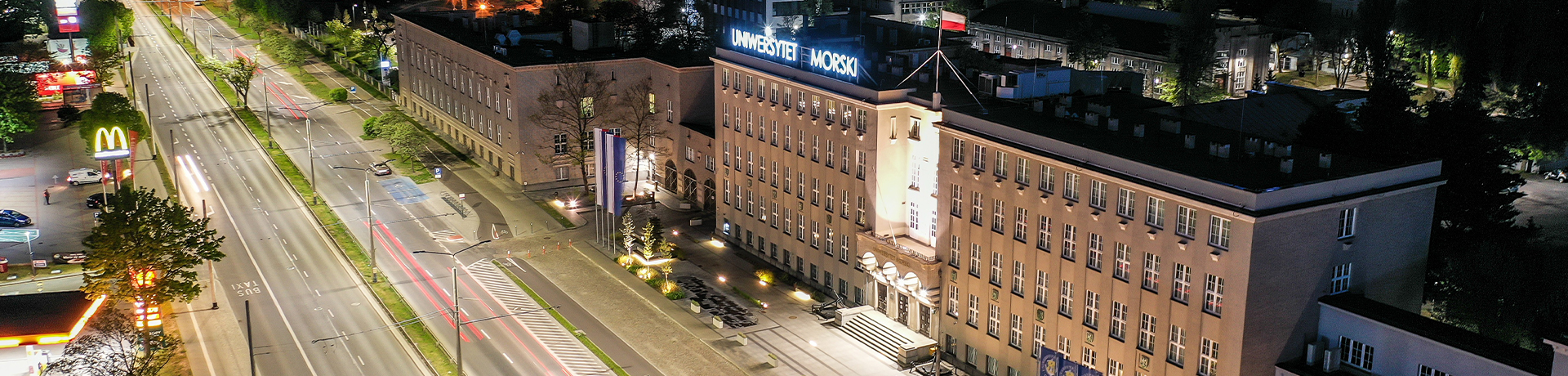
105th Anniversary of Maritime Education in Poland
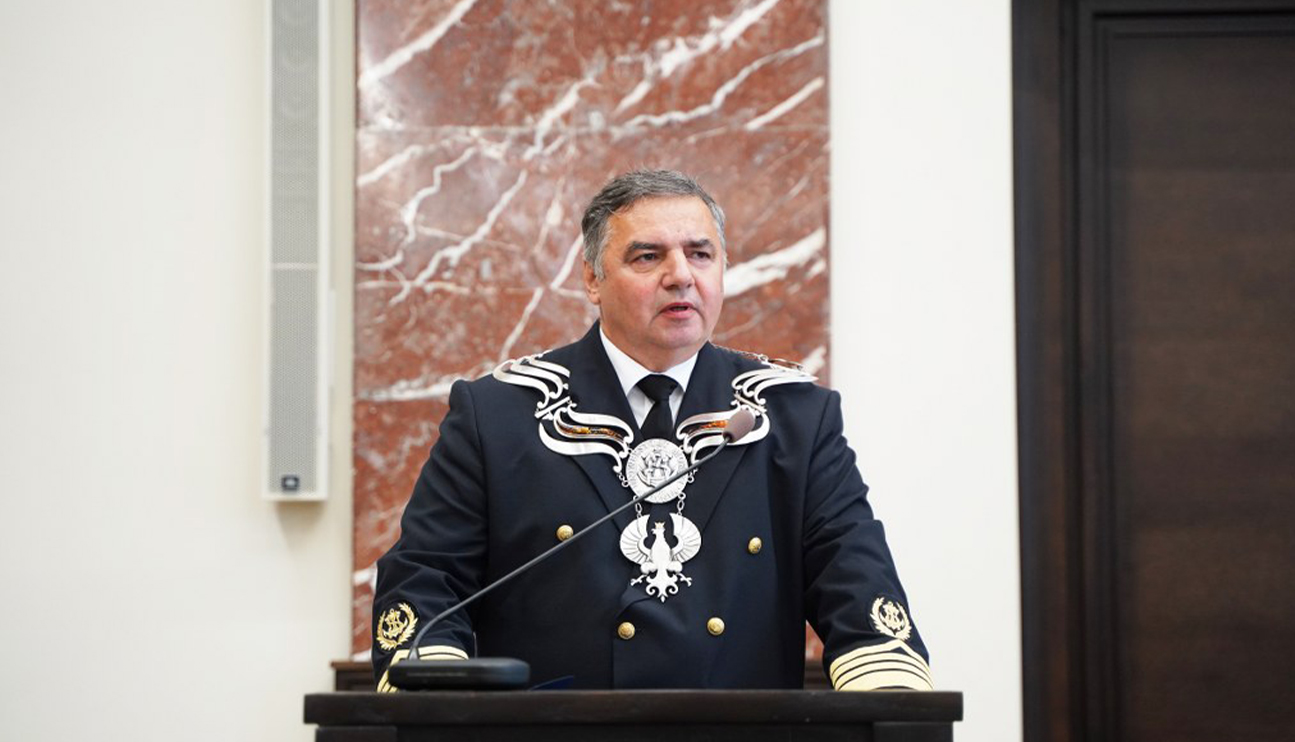
Address of HM The Rector of Gdynia Maritime University,
Professor Adam Weintrit
for the 105th Anniversary of Maritime Education in Poland
Ladies and Gentlemen!
It gives me great pleasure to welcome you to this event, so special in the history of our University – the 105th anniversary of the establishment of maritime education in Poland. One hundred and five years ago, on 17 June, the then Minister of Military Affairs, General Józef Leśniewski, signed the order establishing the Maritime School in Tczew. That decision determined the founding of the School whose work our University continues today. It also influenced the further fate of our country – its economic development, and its maritime military strength, which proved so important just over a decade later, at the outbreak of the Second World War.
Ladies and Gentlemen, today marks exactly 105 years since that historic decision to open our country to the sea. In December, in turn, we will solemnly celebrate 105 years of the existence of our University – first the Maritime School, and today Gdynia Maritime University. I feel proud that, in such a distinguished gathering of guests present in this hall, I can pay tribute to the work of past generations. Without their determination, courage and resourcefulness, there would be no Polish blue economy growing in strength, for which our University educates future personnel.
It is therefore with even greater pleasure that I will make the traditional summary of the past six months, recalling the most important events in the life of our University, and sharing with you our successes and plans for the future. I will not be able at this moment to mention all the achievements of our Staff and Students – you will learn of them in the second part of this ceremony when distinctions, decorations and awards are presented. This is the part of the Open Session of the Senate that I particularly enjoy. It allows me to congratulate you personally on your successes, to thank you for your commitment and daily effort, and to express my recognition of the impressive results of your work. Allow me, however, at this point to express my words of thanks to all of you for our shared work for Gdynia Maritime University – the oldest maritime University in the country, which we are building together.
Ladies and Gentlemen!
The recent months of this year have seen numerous meetings, visits and discussions held with representatives of the Government of the Republic of Poland in connection with the plans to build the successor to the Dar Młodzieży. This topic was covered by the media, so you have certainly had the opportunity to hear or read about the actions we have undertaken, including the meeting with Members of the Polish Parliament, Wioleta Tomczak and Piotr Strach, held on 16 January aboard the Dar Młodzieży. Less than a month later, on 6 February, a meeting was held at the University with the Deputy Minister of Infrastructure, Dr Arkadiusz Marchewka, during which the schedule of work connected with the construction of the successor to the Dar Młodzieży was discussed, and the design concept for the new sailing ship was presented.
Ladies and Gentlemen!
On 14 March, the Dar Młodzieży set out on her first voyage of the year, opening the 2025 sailing season. While our training frigate was cutting through the waters of the Baltic, we were working diligently to obtain the necessary decisions that would allow work to begin on the construction of the new sailing ship. A particularly good opportunity to raise this subject was the external meeting of the Committee on Maritime Economy and Inland Navigation, held on 26 March here, in the T. Meissner Auditorium at Gdynia Maritime University.
The meeting was attended by Members of the Sejm of the Republic of Poland – members of the Committee on Maritime Economy and Inland Navigation, including members of its praesidium: Chair Kacper Płażyński, Deputy Chairs Krzysztof Szymański and Jarosław Wałęsa, as well as Dorota Arciszewska-Mielewczyk, Piotr Głowski, Stanisław Lamczyk and Rafał Siemaszko. The meeting was also attended by the Deputy Voivode of Pomerania, Emil Rojek.
On that day, I opened the meeting with a presentation entitled ‘Maritime Education in the Age of Contemporary Challenges of World Shipping’, during which I sought to present to the parliamentarians and participants of the event the most important challenges in the education of merchant fleet personnel faced every day by maritime universities, not only in Poland but also around the world. It was an honour for me, but also an obligation towards those involved in maritime education.
This address was also an opportunity to once again draw the attention of decision-makers to the necessity of building a successor to the Dar Młodzieży, which lies not only in the interest of the University, but also in the interest of our country – its blue economy, maritime education and Poland’s image in the world. It is impossible not to appreciate the special role played by the Dar Młodzieży as an ambassador of Poland as she sails across the seas and oceans of the world with the Polish flag spread in the wind, the logo of our University on her side, and our students and lecturers on board.
Ladies and Gentlemen!
On 9 April 2025, I had the pleasure of taking part in the Ordinary General Meeting of the Members of the Shipbuilding Employers’ Association FORUM OKRĘTOWE, where one of the important points of the Meeting was the adoption of a Resolution supporting the idea of building a successor to the Dar Młodzieży. The honorary guest of the Meeting was Zygmunt Choreń, known as the ‘Father of Sailing Ships’, the designer of our White Frigate, the Dar Młodzieży. When he took on this task more than 40 years ago, he was a young designer at the Gdańsk Shipyard, a sailor who had recently returned from taking part in a round-the-world race. The list of vessels designed by Mr Choreń includes more than 20 ships, and it was he who handed me the letter with the Resolution supporting the idea of building a successor to the Dar Młodzieży.
Ladies and Gentlemen!
On 24 April, representatives of our University once again took part in a meeting of the Sejm Committee on Maritime Economy and Inland Navigation, where one of the topics discussed concerned the current functioning of maritime universities, including Gdynia Maritime University, the investment needs of our University and the challenges connected with educating future maritime personnel, including the construction of the successor to the Dar Młodzieży.
In mid-May, the media reported a statement by the Prime Minister of the Republic of Poland, Donald Tusk, who, during the opening of the 11th International Maritime Congress in Szczecin, one of the most important maritime industry events in Poland and Europe, announced the allocation of PLN 400 million for the construction of a new sail training ship for Gdynia Maritime University, the successor to the Dar Młodzieży.
I proudly inform you that today our University can say that we have moved from the planning stage of the construction of the successor to the Dar Młodzieży to the implementation of this task, which is of utmost importance for our students and for the entire University.
Ladies and Gentlemen!
History is unfolding before our eyes. As Rector, I am not only moved by this fact, but above all grateful to all those who, over the past months, have said ‘yes’ to this project. I thank the representatives of the Government of the Republic of Poland. I also thank my closest colleagues, who have worked so intensively to ensure that we can continue this proud tradition of training our students under sail.
Ladies and Gentlemen!
The Dar Młodzieży is not the only ship on which our students are trained. On 3 June, our University training and research vessel Horyzont II set out on a voyage to Spitsbergen with 19 student trainees from the GMU Faculty of Electrical Engineering, their faculty supervisor, a student from the Faculty of Navigation, and 12 polar researchers from the Institute of Geophysics of the Polish Academy of Sciences. The ship is commanded by Captain Ryszard Dwurlik.
As part of the expedition to Spitsbergen, Horyzont II, in addition to her training function, will also perform supply functions, delivering during the voyage cargo consisting of supplies for research stations – food, fuel, materials necessary for the functioning of the stations, and research equipment.
Ladies and Gentlemen!
I have outlined to you in detail our efforts to obtain a new vessel for our maritime University. These are not the only actions we are taking to raise the standards of teaching and logistics at our University. In recent months, we have worked intensively to obtain additional funds for investments that will improve the comfort of studying. With much joy, I can announce today that these efforts have been successful. In April, the Ministry of Infrastructure awarded our University PLN 20 million, for the renovation of student residences and teaching rooms, as well as for improving the University’s cybersecurity and supporting its scientific and research development, and more. For this, I would like to express my sincere thanks to the Ministry of Infrastructure.
Ladies and Gentlemen!
We are a University whose name proudly proclaims its home city – Gdynia Maritime University. For years, our experts have invariably been involved in and supported all initiatives serving to improve the quality of life in Gdynia, sharing their knowledge and experience with its residents. We, too, can count on the favour of the authorities of the City of Gdynia for the activities undertaken by the University, for which I am extremely grateful.
An expression of our mutually beneficial activities was the visit of the city authorities to our University on 9 April, when we hosted the Mayor of Gdynia, Aleksandra Kosiorek. On that day, many years of cooperation between Gdynia Maritime University and the City of Gdynia were formalised. Under the agreement signed, cooperation will be deepened in the fields of urban mobility, transport and logistics.
We are very pleased with this cooperation. We are pleased with the initiatives that we implement in cooperation with the city. All the more so, it was an honour and a pleasure for me to participate in the first meeting of the Honorary Committee for the Celebration of the 100th Anniversary of Gdynia, to which I have been appointed. The long-standing Editor-in-Chief of Uniwersytecki Kurier Morski, Małgorzata Sokołowska, has also been included in the work of the Honorary Committee for the Celebration of the 100th Anniversary of Gdynia.
At this point, I would also like to mention that our University’s infrastructure has received recognition from experts. On 10 February, during the ceremonial session of the City Council marking the 99th anniversary of Gdynia being granted city rights, the Gdynia Maritime University Sports and Recreation Centre was honoured. The “Czas Gdyni” award in the ‘Architecture’ category was presented to the Art Projekt K&M design studio for its design of the building.
Ladies and Gentlemen!
Speaking a moment ago about the agreement signed with the City of Gdynia, I cannot fail to mention the business agreements that have also been signed. In April, the University signed a cooperation agreement with Polish Ocean Lines, and with the students of the Faculty of Computer Science in mind, we signed an agreement with Intel, under which potential areas of cooperation were identified, such as student placements at Intel, workshops, lectures, study visits for students conducted by Intel experts, as well as joint research and development projects and events such as career fairs and hackathons.
Ladies and Gentlemen!
The past months have also been marked by the intensification of existing cooperation, as well as the conclusion of new agreements, both national and international in character. During this period, with our current and future students in mind, we also undertook the organisation of many successful initiatives.
In mid-March, Gdynia Maritime University, as the leader of a Consortium composed of Gdynia Maritime University, the Polish Naval Academy and MEWO S.A., signed three agreements with the Maritime Office in Gdynia for the implementation of the task entitled ‘Identification and Possible Neutralisation of Hazardous Materials Resting on the Seabed of the Baltic Sea in Selected Locations’.
On 19 March, a meeting was held with the participation of the University authorities and the General Representatives of Flanders in order to deepen cooperation with Belgium. Gdynia Maritime University has cooperated with Antwerp Maritime Academy since 2008. Let me recall here that the training of students from Antwerp continues the shared education dating back to 1940 at the Faculty of Navigation of University College in Southampton, where Polish cadets and more than a dozen Belgian cadets studied together.
In April, we hosted at the University a representative of the Maritime and Port Authority of Singapore, Regional Director Europe, International Division, Sin-Yee Loh. The event was an opportunity to discuss the potential framework for cooperation between the parties. In April, we also hosted at our University the Ambassador of the Republic of Albania to Poland, Mimoza Halimi. The purpose of this meeting was to discuss potential cooperation, especially in the field of maritime education, including the possible exchange of students of maritime programmes. In May, in turn, as part of long-standing cooperation, we hosted participants of the 20th Polish-German Student Seminar ‘Managing Cultural Diversity in Europe’, organised by Gdynia Maritime University and Hochschule Bremerhaven – University of Applied Sciences under the patronage of the Rectors of both Universities.
In the second half of May, we also hosted at the University representatives of the National Defence College of Nigeria in order to discuss potential academic cooperation between the parties.
Ladies and Gentlemen!
We have also taken part in international sessions and scientific conferences, both as participants and as organisers.
In April, a webinar was held as part of the Transport Research Observatory, with the participation of experts from Poland and abroad representing the transport sector, EU funds, cybersecurity and military mobility. I had the pleasure of participating in this event.
In May, in turn, I had the honour of taking part in the European Navigation Conference 2025, hosted by the Polish Navigation Forum in cooperation with the European Group of Institutes of Navigation, where, as Deputy-Chair of the Polish Navigation Forum, I took part in the plenary session.
At the beginning of June, two international conferences were also held at the University: the 12th International Scientific Conference in the series ‘The Role of Commodity Science in Quality Management in a Knowledge-Based Economy’, organised by the Faculty of Management and Quality Science, and the 21st edition of the International Conference on Smart Technologies – IEEE EUROCON 2025, held at the Gdynia Science and Technology Park and organised with the participation of the Faculty of Computer Science.
Ladies and Gentlemen!
A few days ago, the 16th edition of the International Conference on Marine Navigation and Safety of Sea Transportation, TransNav, came to an end, which we organised together with The Nautical Institute. During this event, held on 11-13 June, we hosted at our University 250 experts in the maritime economy from all over the world. The conference, like its previous editions, was addressed to scientists and specialists from research centres for the purpose of transferring knowledge, experience and research concerning various aspects of navigation, including the safety of navigation and maritime transport.
Ladies and Gentlemen!
Over the past six months, the efforts and achievements of our academic and teaching staff have been noticed and appreciated in Poland.
On 27 January, Professor Janusz Zarębski was decorated with the Officer’s Cross of the Order of Polonia Restituta for outstanding services to the development of the maritime economy and for achievements in scientific, teaching and organisational work.
In February, the Minister of Science and Higher Education appointed Dr Tomasz Studzieniecki, an employee of the Department of Marketing and Quantitative Methods, to the Management Committee of the ‘PEACE’ Project, financed from the European Cooperation in Science and Technology Programme – Horizon Europe.
In March, Professor Janusz Mindykowski, Head of the Department of Marine Electrical Power Engineering at the GMU Faculty of Electrical Engineering, was elected a member of the Disciplinary Committee operating under the General Council of Science and Higher Education for the 2025-2028 term.
In April, we received information that Dr Mateusz Gil, Assistant Professor in the Department of Navigation of the Faculty of Navigation, would receive the full amount of funding for the implementation of the project ‘Maritime Interactive Navigation and Collision Avoidance System for Autonomous Ships’ – MARINERS, awarded in the 15th edition of the LIDER programme. The results were announced by the National Centre for Research and Development.
Funding for the implementation of a project was also received by Dr Łukasz Janowski, a researcher at the Department of Operational Oceanography of the GMU Maritime Institute. The project entitled ‘VILAMAP: The Vistula Lagoon Mapping Project. A High-Resolution Remote Sensing Approach for Better Environmental and Archaeological Understanding’ received funding under the SONATA 20 call of the National Science Centre.
Ladies and Gentlemen!
I am also delighted by the successes of our students, and therefore I warmly congratulate a student of our University from the Faculty of Navigation, Wiktoria Dumińska, who on 6 March received the City of Gdynia Scholarship for outstanding scientific achievements in the 2023/2024 school year. This is not Wiktoria’s only success. At the end of May, she became a finalist of the nationwide Student Nobel 2025 competition in the technical sciences category.
Ladies and Gentlemen!
I am also extremely pleased by the successes of the Technology Transfer Office.
In May, the Patent Office of the Republic of Poland granted our University the right to register the industrial design entitled ‘Hybrid Cutting Tool’. The creator of this innovative solution is Dr Olga Łastowska, Assistant Professor in the Department of Engineering Sciences at the GMU Faculty of Marine Engineering.
At the beginning of June, during the 18th International Fair of Inventions and Innovations INTARG 2025, held at the International Congress Centre in Katowice, three medals were awarded for innovative solutions. Two gold medals and one silver medal went to GMU research teams for:
A GOLD MEDAL for a method of producing polyester-glass-rubber sandwich panels using vacuum fusion, where the creators of the awarded innovation are Dr Daria Żuk, Dr Katarzyna Panasiuk and Norbert Abramczyk from the Faculty of Marine Engineering;
A GOLD MEDAL for polyurethane foam modified with nanochitosan, received by its creators Professor Joanna Brzeska from the Faculty of Management and Quality Science, together with Dr Agnieszka Piotrowska-Kirschling; and
A SILVER MEDAL for a hybrid cutting tool for removing weld excess, awarded to its creator, Dr Olga Łastowska from the Faculty of Marine Engineering.
Ladies and Gentlemen!
Behind us are also events addressed directly to our students, as well as to candidates interested in undertaking studies at the oldest maritime University in Poland.
On 7 March, we hosted more than 1,000 people during the first Open Day of Gdynia Maritime University this year, organised with future students of our University in mind.
On 10 April, Electrical Engineer’s Day was held in the sports hall of the Sports and Recreation Centre, an event organised in a new format with the participation of the authorities, staff and students of the Faculty of Electrical Engineering, and with current and future students of the University in mind. More than 300 people took part in Electrical Engineer’s Day, including pupils from six secondary schools, as well as representatives of companies from the energy, electronics, IT and autonomous-systems sectors interested in cooperating with students and future graduates of Gdynia Maritime University.
On 6, 13 and 15 May, the annual sports and recreational event organised by Gdynia Maritime University – GMU Sports Day – took place, for the second year in a row, at the GMU Sports and Recreation Centre.
Also in May, the first edition of Navigator’s Day, organised by the Faculty of Navigation, took place. During this event, among other things, a career fair dedicated to students of maritime programmes was held.
Behind us is also the extremely successful second edition of the Maritime Festival of Science, which took place on 5-7 June and was attended by hundreds of people interested in workshops, lectures and interactive classes organised by staff from all the University’s Faculties.
In my view, the initiatives I have mentioned are extremely valuable, as they integrate our academic community with the communities in the Tri-City and with all those interested in our University from outside the Tri-City area.
Ladies and Gentlemen!
In the past six months, two balls were held: the traditional Maritime Ball and the Student Ball organised by the GMU Student Parliament. This year, also for the second time after the pandemic break, thanks to the support of the authorities of the City of Gdynia, the student festival Delfinalia took place – a celebration of the University’s students, but also an opportunity to promote our University, especially among young people from outside the region.
Ladies and Gentlemen!
As I have already said today, the home of our University is Gdynia. We are a proud part of the community of this city, and therefore, with undisguised joy, we are always pleased to be involved in events connected with the life of Gdynia, as well as Pomerania itself.
The residents of this land are important to us, and therefore, in this academic year, with the people of Gdynia in mind, though not only, we ran a popular science project entitled ‘Local Science Advocates’ – a series of open lectures, to which we will return after a short summer break.
This calendar year, specifically on 10 February, in memory of the events of 1920, when General Józef Haller, Commander of the Pomeranian Front, implementing the provisions of the Treaty of Versailles, performed the symbolic Marriage of Poland to the Sea, we took part, together with our students, in the 105th anniversary of the Marriage of Poland to the Sea in Puck. On that day, we were also present in Gdynia, celebrating the 99th anniversary of the city being granted municipal rights.
It was also from our University, on the eve of Librarian’s Day – 7 May – that the impulse came to organise annual meetings of representatives of librarians from all Tri-City higher education centres, the Library of the Polish Academy of Sciences in Gdańsk, and the Municipal Public Library in Gdynia, as part of Library Week, creating a forum for the exchange of ideas among Tri-City academic librarians.
Ladies and Gentlemen!
Gdynia Maritime University is a University with a rich tradition and history.
In the past six months, on 23-24 March, we had the honour of taking part in the celebrations of the 120th anniversary of the birth of Captain Karol Olgierd Borchardt, patron of the Library of Gdynia Maritime University, an outstanding teacher of astro-navigation and educator of many generations of seafarers, as well as a maritime writer whose works, in which he described service on board the Lwów and the Dar Pomorza, in many cases influenced young people’s decisions to join the merchant navy.
Ladies and Gentlemen!
On 30 January 1920, Tczew officially returned to Poland. This symbolic incorporation, under the Treaty of Versailles, was carried out by soldiers of the Pomeranian Front under the command of General Józef Haller. In the same year, by order of General Józef Leśniewski, the Maritime School was established, and Tczew was chosen for its location.
It was an honour for us to be able to take part in the celebrations commemorating the events of 105 years ago. The celebrations, entitled ‘Maritime Inspirations…’, took place at the Maria Skłodowska-Curie 1st General Secondary School in Tczew, which is located in the original building of the Maritime School.
Ladies and Gentlemen!
In this brief address, I have certainly not been able to mention all our achievements from the past several months, nor all of your successes. Our quarterly newsletter, Uniwersytecki Kurier Morski, serves as a record of University events, and its latest issue is already available for you to read. I also encourage you to follow our website, where we regularly publish the most important news from the life of the University.
Ladies and Gentlemen!
In a moment, the second part of the Open Session of the Senate will begin, during which awards, medals and distinctions will be presented. Concluding my address, I wish to thank you most sincerely for your presence and to congratulate all those who will be honoured. This is a special moment, when, through distinctions and awards, we can thank you for your commitment, dedication and the high standard of your work. For all of this, I once again thank you most sincerely.