
Rector's Address
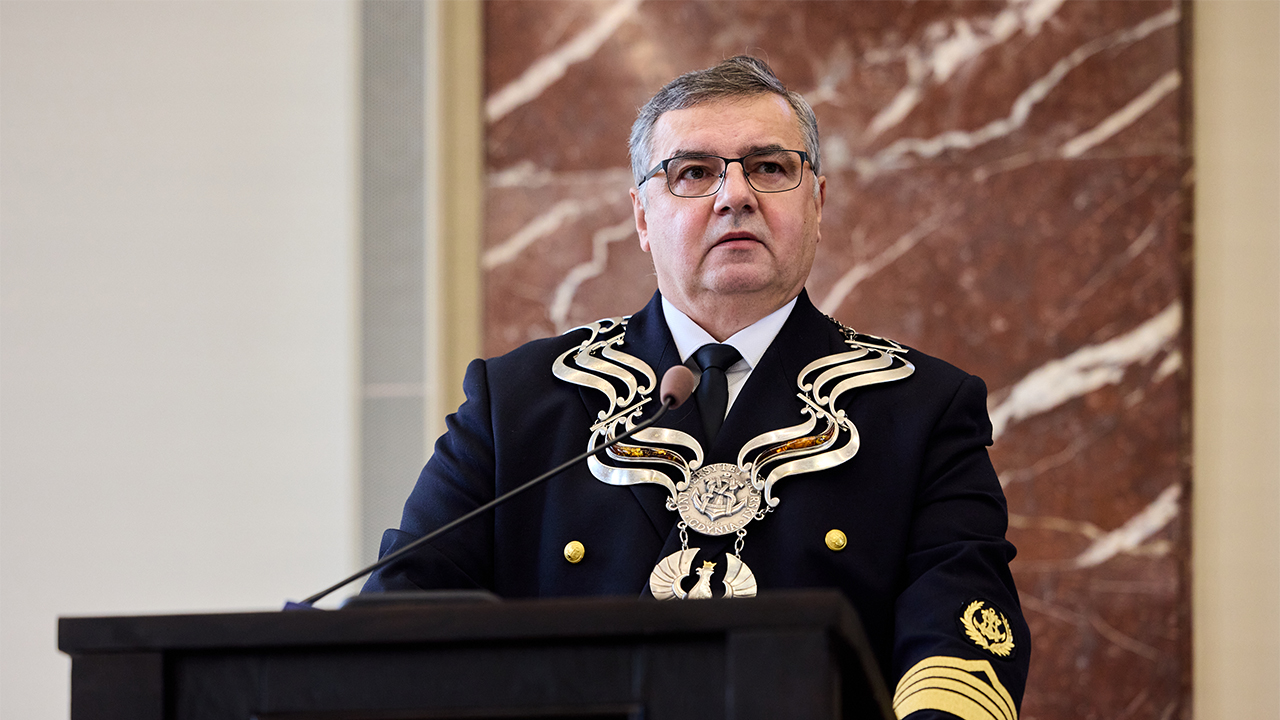
Address of HM The Rector of Gdynia Maritime University,
Professor Adam Weintrit, during University Celebration Day on 9 December 2025
Honourable Senate!
Ladies and Gentlemen!
Thank you for accepting our invitation to take part in the celebration of our University. We meet today in memory of the events of 8 December 1920, when the Polish flag was raised for the first time on the building of the Maritime School in Tczew and the first school year was ceremonially inaugurated.
Ladies and Gentlemen!
Our University celebrates twice a year, which makes it all the more pleasing that I am meeting some of you for the second time this year. A few months ago, in June, we had the opportunity to commemorate together the events of 17 June 1920, when the Minister of Military Affairs, General Józef Leśniewski, signed the order establishing the Maritime School in Tczew, the predecessor of Gdynia Maritime University.
Both of these dates are equally important to our academic community. Although 105 years have now passed since then – 105 years of intensive work – those events remain very much alive for us. That is why we return to them so often.
Ladies and Gentlemen!
It will be no exaggeration if I say that, for our University, 2025 has been an exceptional year. A breakthrough year in many respects. And it will certainly be written into the history of the University. Before, however, I move on to a brief summary of the most important events of the past twelve months, allow me to offer my sincere thanks to all staff at our University present here today for your year-round effort and commitment to all matters concerning Gdynia Maritime University. I am convinced that without your work for our University and its students, for Polish science and for the blue economy, we would not be where we are today. I appreciate this deeply, and I offer you my utmost respect. I also thank all those who have supported us, shown us goodwill, helped us and cooperated with us.
University Celebration Day, celebrated on 8 December, is an excellent occasion to thank everyone in your presence here today. For this, the University works and lives thanks precisely to your activity. In celebrating today the anniversary of a specific event, we also honour the work of hundreds, indeed thousands, of people who, over the past century, have contributed to the creation of this School. And today we honour the achievements of those of you present here. That is why I already wish to congratulate most sincerely all those who, in a moment, during the second part of the Open Session of the Senate, will receive distinctions, decorations or awards. This is your success and the result of hard, year-long work for the University, for which I am extremely grateful.
Ladies and Gentlemen!
The year 2025 has undoubtedly been marked by numerous meetings, visits and discussions with representatives of the Government of the Republic of Poland, the Sejm and the Senate, as well as with experts involved in the plans connected with the construction of the successor to the Dar Młodzieży. The media followed this topic closely and commented on it. From the beginning of this year, the project was accompanied by tremendous support, which our University received from many different communities, institutions and organisations, as well as from journalists. Throughout the entire process, we were also very actively supported by Parliamentarians. That is why, already at the beginning of 2025, on 6 February, during a meeting at the University with the Deputy Minister of Infrastructure, Dr Arkadiusz Marchewka, the direction of further action was set, the schedule of work connected with the construction of the successor to the Dar Młodzieży was discussed, and the design concept for the new sail training ship was presented.
Ladies and Gentlemen!
On 26 March, two weeks after the Dar Młodzieży had opened the new sailing season, we once again had the opportunity at the University to draw the attention of decision-makers to the necessity of building a successor to the Dar Młodzieży, which lies not only in the interest of the University, but also in the interest of our country. I had the opportunity to present this matter during the external meeting of the Committee on Maritime Economy and Inland Navigation, held here in the T. Meissner Auditorium at Gdynia Maritime University.
On that day, the meeting, which I opened with a presentation entitled ‘Maritime Education in the Age of Contemporary Challenges of World Shipping’, was attended by Members of the Sejm of the Republic of Poland – members of the Committee on Maritime Economy and Inland Navigation, led by its Chair, Kacper Płażyński, and his Deputies, Krzysztof Szymański and Jarosław Wałęsa. The meeting was also attended by the Deputy Voivode of Pomerania, Emil Rojek. The presentation was an honour for me, but also a great obligation towards the community of people of the sea, and especially towards those involved in maritime education and training.
Ladies and Gentlemen!
In the second quarter of this year, on 9 April, during the Ordinary General Meeting of the Members of the Shipbuilding Employers’ Association Forum Okrętowe, in which I had the pleasure of taking part, another key event connected with the construction of the successor to the Dar Młodzieży took place: the adoption by Forum Okrętowe of a Resolution supporting the idea of building a successor to the Dar Młodzieży. It was handed to me by the honorary guest of the Meeting, Zygmunt Choreń, known as the ‘Father of Polish Sailing Ships’, the designer of our current White Frigate, the Dar Młodzieży.
Also in April, in the second half of the month, the subject of building a successor to the Dar Młodzieży once again appeared on the agenda of the Sejm Committee on Maritime Economy and Inland Navigation, as part of one of the topics discussed concerning the current functioning of maritime universities, during which the University authorities once again presented the matter before Parliamentarians.
Ladies and Gentlemen!
During the opening of the 11th International Maritime Congress in Szczecin, one of the most important maritime industry events in Poland and Europe, the Prime Minister of the Republic of Poland, Donald Tusk, announced the allocation of PLN 400 million for the construction of a new sail training ship for Gdynia Maritime University, the successor to the Dar Młodzieży.
We received this information as a good sign for the months ahead. And so it proved to be, because on 30 September 2025, a historic decision for Gdynia Maritime University and for the Polish blue economy was made concerning the financing of the construction of the successor to our sail training ship, the Dar Młodzieży. On that day, the Council of Ministers adopted a resolution establishing the multiannual programme ‘Construction of Ships for the Maritime Universities in the Years 2025–2029’, prepared by the Ministry of Infrastructure.
Ladies and Gentlemen,
A few days after the Government’s decision, during the ceremonial inauguration of the academic year on 4 October, aboard the Dar Młodzieży, we had the honour of hosting the Prime Minister of the Republic of Poland, Donald Tusk, who in his address referred to the adopted resolution, which later that same day was handed to me by the Minister of Infrastructure, Dariusz Klimczak.
Also in October, during the Maritime Economy Forum, in a presentation concerning the construction of the successor to the Dar Młodzieży, I publicly presented for the first time the key assumptions for this investment, as well as the schedule for the construction of the University’s new sailing ship.
On the same day, 10 October, also during the Maritime Economy Forum, the competition to name the successor to the Dar Młodzieży was announced. The competition is still open. I warmly encourage you to take part. Perhaps someone present here today will propose the winning name and be written into the history of our University.
And here I owe you an important announcement. The current regulations published on our website state that name proposals may be submitted until 17 February 2026. Following consultations held at the Ministry of Infrastructure, with the participation of representatives of the Prime Minister’s Office, we have decided that this period will be extended until the end of May, and that the name of the new sailing ship, the successor to the Dar Młodzieży, will be officially announced during the next celebration of our University, that is, on 17 June 2026.
Ladies and Gentlemen,
We have an ambitious plan to hand over the new ship to students as early as 2028, and although the new vessel will be equipped with the latest technologies, future officers of the merchant fleet, students of the University, as well as pupils from maritime secondary schools, will still undergo traditional sea training using muscle power, youthful fitness and physical strength, including learning to sail under canvas.
The Dar Młodzieży, whose successor we have worked so intensively to secure, is not the only ship on which our students are trained. This year, as is tradition, practical training also took place on our training and research vessel, the Horyzont II, which in June and at the turn of August and September made two voyages to Spitsbergen. On board were student trainees from the GMU Faculty of Electrical Engineering and Faculty of Navigation, as well as polar researchers from the Institute of Geophysics of the Polish Academy of Sciences.
As part of the expeditions to Spitsbergen, the Horyzont II, in addition to her training function, also performs supply functions, delivering during the voyage cargo consisting of supplies for research stations – food, fuel, materials necessary for the functioning of the stations, and research equipment.
At this point, we should also mention our third vessel – the research vessel Imor, on which GMU Maritime Institute staff conduct environmental research, in recent times mainly for the needs of offshore wind energy, the Chief Inspectorate of Environmental Protection and the Maritime Office.
Ladies and Gentlemen!
Our University is constantly making efforts to obtain funding that will allow us to raise the standards of education and logistics at the University. The actions we have undertaken in this area were also successful this year. In April, the Ministry of Infrastructure awarded our University an additional PLN 20 million, among other things, for the renovation of student residences and teaching rooms, as well as for improving the University’s cybersecurity and supporting its further scientific and research development.
At this point, I would like to mention that our University’s infrastructure has received recognition from experts, and two of our new facilities have been noticed and appreciated. On 10 February, during the ceremonial session of the City Council marking the 99th anniversary of Gdynia being granted city rights, the Gdynia Maritime University Sports and Recreation Centre was honoured. The ‘Czas Gdyni’ award in the Architecture category went to the Art Projekt K&M design studio for designing the building of the Gdynia Maritime University Sports and Recreation Centre. Nine months later, during the October Maritime Economy Forum, Gdynia Maritime University received the Amber Duck award for creating the GMU Offshore Centre, a key centre and the seed of the Polish offshore valley, conducting offshore research and measurements for the offshore wind energy sector. The Amber Duck is an award for the best companies in the maritime industry, granted by the Polish Chamber of Maritime Commerce.
Ladies and Gentlemen!
Our University is proudly rooted in Gdynia, and the fact that the city’s name forms part of our own is a source of great pride and satisfaction. The links between the city and the University are reflected in the cooperation that we have pursued for years with the authorities and residents of Gdynia, and our graduates often decide, after completing their studies, to remain in the city and develop their professional careers here. Undoubtedly, the port, the shipyard and our University have played a city-forming role in Gdynia. All the more pleasing is the fact that, in April this year, many years of cooperation between Gdynia Maritime University and the City of Gdynia were formalised. The agreement signed on that day is intended to further deepen cooperation in the fields of urban mobility, transport and logistics.
Ahead of us are the celebrations of the 100th anniversary of Gdynia. I am extremely pleased to have received an invitation to join the work of the Honorary Committee for the Celebration of the Centenary of Gdynia. I am also pleased that Małgorzata Sokołowska, long-standing editor of Uniwersytecki Kurier Morski and author of many books devoted to our city and its residents, has been included in the Committee’s work.
As part of next year’s celebrations, at the beginning of November, I had the honour of taking part in a press conference devoted to the events connected with our city’s birthday. During the conference, I received from the authorities of the City of Gdynia a symbolic miniature of the centenary sail, which, in the appropriate scale, will be carried on the jib of the Dar Młodzieży in the jubilee year 2026.
And the season, Ladies and Gentlemen, promises to be exceptionally attractive. We have decided that, following appropriate preparations, which are already underway, the Dar Młodzieży will take part in the prestigious Sail 2026 event in the United States, a regatta marking the 250th anniversary of the independence of the United States, on the route Norfolk – Baltimore – New York – Boston. The culmination of the event will be the anniversary celebrations on 4 July 2026 in New York. We cannot fail to be present at these celebrations.
Ladies and Gentlemen!
I cannot neglect to mention the business agreements signed this year. In April, the University signed a cooperation agreement with Polish Ocean Lines. With the students of the Faculty of Computer Science in mind, we signed an agreement with Intel, under which potential areas of cooperation were identified, such as student placements at Intel, workshops, lectures and study visits for students conducted by Intel experts, as well as joint research and development projects and events such as career fairs and hackathons. Also with our students in mind, at the end of July, the University signed a letter of intent with the District Heating Company OPEC. The document provides for the establishment of long-term cooperation, under which a range of activities will be undertaken, among other things, in the area of developing the scientific and professional potential of GMU students, including the organisation of professional placements and internships.
Ladies and Gentlemen! I would also like to mention that we are working intensively on the internationalisation of the University, although, for various reasons, its most visible effects are still ahead of us. We are also working on launching new degree programmes and pathways, including in cooperation with our external partners, that is AGH University of Krakow, the Fire University in Warsaw and the Polish Naval Academy.
Ladies and Gentlemen!
In 2025, we intensified existing cooperation and also established new partnerships. We also undertook the organisation of many successful national and international initiatives.
In March, the University, as the leader of a Consortium composed of Gdynia Maritime University, the Polish Naval Academy and MEWO S.A., signed three agreements with the Maritime Office in Gdynia for the implementation of the task entitled ‘Identification and Possible Neutralisation of Hazardous Materials Resting on the Seabed of the Baltic Sea in Selected Locations’.
In the spring of this year, we also hosted diplomatic representatives at the University, including those from Flanders, in order to deepen cooperation with Belgium, with which Gdynia Maritime University has cooperated since 1940. It is worth recalling that the training of students from Antwerp, which is still conducted at the University today, continues the shared education dating back to 1940 at the Faculty of Navigation of University College in Southampton, where Polish cadets and more than a dozen Belgian cadets studied together.
Also in April, we hosted at the University the Ambassador of the Republic of Albania to Poland, Mimoza Halimi. The purpose of the meeting was to discuss potential cooperation with the University, above all in maritime education and student training.
An opportunity to discuss the potential framework for cooperation was also provided by a meeting with a representative of the Maritime and Port Authority of Singapore, Regional Director Europe, International Division, Sin-Yee Loh.
In May, as part of long-standing cooperation, the 20th Polish-German Student Seminar ‘Managing Cultural Diversity in Europe’ was held at the University, organised by Gdynia Maritime University and Hochschule Bremerhaven– University of Applied Science under the patronage of the Rectors of both Universities.
In October, I met twice with the new Consul General of Germany in Gdańsk, Karl-Matthias Klause: once on board the Dar Młodzieży during the inauguration of the academic year, and a few days later at the European Solidarity Centre, where I took part in the ceremony marking German Unity Day.
In the second half of May, we also hosted representatives of the National Defence College of Nigeria at the University. The purpose of the meeting was to discuss potential academic cooperation between us.
In July, in the Polish Pavilion during Expo 2025 in Japan, a cooperation agreement was signed between Gdynia Maritime University and the Faculty of Maritime Sciences of Kobe University. This partnership will enable closer international cooperation in the area of scientific research and education in maritime sciences. The agreement also provides for the exchange of students and academic staff.
In August, a delegation from Gdynia Maritime University took part in the celebrations of the 50th anniversary of Hochschule Bremerhaven – for more than forty years a partner university of our University, with which GMU has cooperated since 1978. The celebrations, attended by the University delegation, took place, among other places, on board the Dar Młodzieży, which on 13 August this year entered the port of Bremerhaven with trainees from Gdynia Maritime University on board.
A month later, we hosted at the University a delegation from Taiwan’s largest port city, Kaohsiung, Gdynia’s sister city. The purpose of the meeting was to discuss potential cooperation between the University and the institutions indicated by the Kaohsiung authorities: National Sun Yat-sen University and National Kaohsiung University of Science and Technology.
In October, the Dice-Rector for Internationalisation, Cooperation and Development, Professor Tomasz Tarasiuk, met with the Chief Operating Officer of the Port of Turku, Antti Pekanheimo, and the Honorary Consul General in Turku, Jari Rastas. These talks are to be continued in the second half of December in Finland.
In the second half of November, we had the pleasure of hosting two foreign delegations at the University, very important for the further development of Gdynia Maritime University. On 17 November, we hosted His Excellency the Ambassador of the Republic of Angola to Poland, Manuel Pedro Chaves. During the visit, we discussed opportunities for cooperation in the education of students and doctoral candidates, as well as the exchange of academic teachers and the conduct of research between Gdynia Maritime University and Angola, including the University of Namibe.
The following day, we hosted a delegation from the Philippines. On that day, a meeting was held between the University leaders and His Excellency the Ambassador of the Republic of the Philippines to Poland, Alan Deniega. During the meeting, we discovered how much our countries have in common. We are connected by culture and religion, but also, which is crucial for our University, by a rich maritime tradition and access to the sea. I hope that, in the near future, both Angola and the Philippines, with their academic centres educating personnel for the blue economy, will enter into closer cooperation with our University in the wider field of maritime education.
At around the same time, I met with the President of the Brittany Region, Loïg Chesnais-Girard, and the Honorary Consul of France, Alain Mompert. This was not my only meeting with the Honorary Consul. A month earlier, there had been a very pleasant meeting at the Rectorate with Czesław Lang, during which both gentlemen informed me that next year’s Tour de Pologne will set off from Gdynia, and that the start of the first stage will take place in Kościuszko Square. I agreed to the use of the area of the Faculty of Navigation for the logistical and technical purposes of the event, of course, with the approval of the Dean, Professor Tomasz Neumann.
Two weeks ago, for the second time this year, we also hosted at the University a delegation of diplomats from Taiwan interested in cooperation with our University, particularly in the education of computer science and programmes.
Ladies and Gentlemen!
I would like to draw attention to our international activity. Over the course of just a few months, we held talks at our University with representatives of Albania, Angola, Belgium, the Philippines, Finland, France, the Netherlands, India, Japan, Malaysia, Germany, Nigeria, Singapore, Taiwan and the United States, not to mention the 83 countries whose representatives took part in the June TransNav Conference.
Ladies and Gentlemen!
The presence of our University within the international scientific community is essential for its continued development. Hence our regular, active participation in, and organisation of, international events.
In April, I had the pleasure of taking part in a webinar organised as part of the Transport Research Observatory, with the participation of experts from Poland and abroad representing the transport sector, EU funds, cybersecurity and military mobility.
In May, as Deputy-Chair of the Polish Navigation Forum, I took part in the European Navigation Conference 2025, hosted by the Polish Navigation Forum in cooperation with the European Group of Institutes of Navigation.
In June, as many as three large international conferences were held, which we organised or co-organised. These were:
the 12th International Scientific Conference in the series ‘The Role of Commodity Science in Quality Management in a Knowledge-Based Economy’, organised by the Faculty of Management and Quality Science,
the 21st edition of the International Conference on Smart Technologies – IEEE EUROCON 2025, organised with the participation of the Faculty of Computer Science,
and the 16th edition of the International Conference on Marine Navigation and Safety of Sea Transportation, TransNav 2025, which we organised together with The Nautical Institute. This event, addressed to scientists and specialists from research centres conducting studies into various aspects of navigation, including the safety of navigation and maritime transport, was attended by as many as 250 blue economy experts from all over the world. Papers presented at this Conference are successively published in the TransNav Journal, indexed in the Scopus and Web of Science databases, which we have published in English since 2007.
At the beginning of September, I once again had the honour of taking part in the 34th Economic Forum in Karpacz. The event gathered more than 6,000 guests, including representatives of business, politics, administration, science and culture. This year’s Economic Forum was held under the motto 'A Time of Change – The Future of Europe'. During the event, I took part as a panellist in a debate devoted to the redefinition of work in a world dominated by artificial intelligence. I also moderated a panel discussion on a similar subject during the most recent meeting of the Transport Committee of the Polish Academy of Sciences, two weeks ago.
In mid-October, a University delegation took part in IAMU AGA 2025 in Chennai, formerly Madras, in India. During this event, the traditional meeting of rectors of universities representing all continents – the President’s Forum – was held, in which I had the pleasure of participating. During the IAMUC conference, whose leading theme was ‘Technologies and Breakthrough Innovations Towards Sustainable Maritime Practices’, papers were delivered by members of the GMU delegation: Professor Adam Przybyłowski, IAMU-GMU Contact Person, doctoral candidate Wiktoria Ceynowa, Captain Dariusz Jellonnek, Director of the GMU Maritime Operations Department, and Captain Paweł Kołakowski. In the student section, IAMUS, papers were delivered by Wiktoria Dumińska and Jakub Kulbat from the Faculty of Navigation. The next IAMU General Assembly will be held in Split, Croatia.
Also in October, I had the honour of opening the conference accompanying the 18th Congress of the Polish Association of Maritime Pilots. During the event, held in Szczecin, I presented a lecture devoted to the challenges faced by pilots in the context of electronic navigation and autonomous navigation. Earlier, in May this year, I delivered a similar address in Krakow at the 59th General Meeting of the European Maritime Pilots’ Association, entitled ‘Maritime Pilotage: The Key Link in the Maritime Industry’.
Ladies and Gentlemen!
At the turn of September and October this year, as a university, we once again took part in the largest and most important economic and cultural event in the world – Expo 2025, Osaka, Kansai, where this time the Gdynia Maritime University Academic Choir, conducted by Dr Karol Hilla, performed a specially prepared musical programme.
Ladies and Gentlemen!
This year has brought numerous awards and decorations granted to our academic and teaching staff in recognition of their merits and achievements.
In January, Professor Janusz Zarębski was decorated with the Officer’s Cross of the Order of Polonia Restituta for outstanding services to the development of the blue economy and for achievements in scientific, teaching and organisational work.
In February, the Minister of Science and Higher Education appointed Dr Tomasz Studzieniecki, a member of staff in the Department of Marketing and Quantitative Methods, to the Management Committee of the ‘PEACE’ Project, financed from the European Cooperation in Science and Technology Programme – Horizon Europe.
In March, Professor Janusz Mindykowski, Head of the Department of Marine Electrical Power Engineering at the GMU Faculty of Electrical Engineering, was elected a member of the Disciplinary Committee operating under the General Council of Science and Higher Education for the 2025-2028 term.
In April, the National Centre for Research and Development informed us that Dr Mateusz Gil, Assistant Professor in the Department of Navigation of the Faculty of Navigation, would receive the full amount of funding for the implementation of the project ‘Maritime Interactive Navigation and Collision Avoidance System for Autonomous Ships’ – MARINERS, awarded in the 15th edition of the LIDER programme.
We were also pleased to receive information about funding awarded to the project of Dr Łukasz Janowski, a researcher at the Department of Operational Oceanography of the GMU Maritime Institute. The project entitled ‘VILAMAP: The Vistula Lagoon Mapping Project. A High-Resolution Remote Sensing Approach for Better Environmental and Archaeological Understanding’ received funding under the SONATA 20 call of the National Science Centre.
In June, in recognition of merits and achievements in the field of hydrographic measurements, the Maritime Institute of Gdynia Maritime University was awarded the Hydrographer’s Laurel 2025 for its exceptional contribution to the bathymetric recognition of Polish maritime areas as part of the project entitled ‘Mapping Benthic Habitats of Polish Maritime Areas Using Sonar Mosaicking of the Seabed in the Years 2021–2023’.
This year, our University was once again included among the universities listed in one of the most recognisable and prestigious university rankings – the Times Higher Education World University Rankings 2026. The ceremonial Gala for the presentation of THE Awards to Polish universities classified in the THE World University Rankings was held, as has become tradition, during the LUMEN Conference organised last week in Krakow. This year’s THE World University Rankings 2026 included 45 universities from Poland, one more than in the previous edition. Our University was placed in the 1501+ band, alongside 20 other Polish universities.
Also in 2025, once again, researchers from our University were included among the prestigious group of the most highly cited scientists in the world according to the World’s Top 2% Scientists 2025 ranking.
Included in the World’s Top 2% Scientists 2025 ranking covering entire scientific career achievements, the following were: Professor Andrzej Stateczny and Professor Agnieszka Lazarowska from the Faculty of Computer Science, as well as Professor Tomasz Tarasiuk, Professor Krzysztof Górecki, Professor Ryszard Strzelecki and Professor Piotr Gnaciński from the Faculty of Electrical Engineering.
In the World’s Top 2% Scientists 2025 ranking, taking into account only scientific achievements in 2024, the following were included: Dr Krzysztof Wróbel and Dr Mariusz Specht from the Faculty of Navigation, Professor Krzysztof Górecki and Professor Paweł Górecki from the Faculty of Electrical Engineering, as well as Professor Agnieszka Lazarowska and Professor Andrzej Stateczny from the Faculty of Computer Science.
Ladies and Gentlemen!
At this point, I would also like to mention the successes of our Technology Transfer Office.
In May, the Patent Office of the Republic of Poland granted our University the right to register the industrial design entitled ‘Hybrid Cutting Tool’. The creator of this solution is Dr Olga Łastowska from the Department of Engineering Sciences at the GMU Faculty of Marine Engineering.
At the beginning of June, during the 18th International Inventions and Innovations Fair INTARG 2025 in Katowice, medals were awarded for innovative solutions, of which two gold medals and one silver medal went to GMU research teams:
Gold Medals were awarded to Dr Daria Żuk, Dr Katarzyna Panasiuk and Norbert Abramczyk from the Faculty of Marine Engineering; and to Professor Joanna Brzeska from the Faculty of Management and Quality Science, together with Dr Agnieszka Piotrowska-Kirschling;
A Silver Medal went to Dr Olga Łastowska from the Faculty of Marine Engineering.
At the beginning of November, we received information about another success of our scientists – the authors of the invention entitled ‘Mobile Electromagnetic Mooring System for Surface Vessels’, Professor Grzegorz Rutkowski and Captain Paweł Kołakowski from the Department of Navigation. The European Patent Office granted exclusive rights to the invention to Gdynia Maritime University and confirmed this with a patent document.
Also in November, the Technology Transfer Office of Gdynia Maritime University, as the first University in Pomerania, obtained accreditation in the area of technical and environmental consultancy in the Business Environment Institutions Database as part of the project ‘Pomeranian System of Information and Advisory Services SPEKTRUM 2030’, implemented by the Pomerania Development Agency.
Ladies and Gentlemen!
The home of our University is Gdynia, which is why we are always very pleased to become involved in events connected with the life of the city and its residents. On 10 February, in memory of the events of 1920, when General Józef Haller, Commander of the Pomeranian Front, implementing the provisions of the Treaty of Versailles, performed the symbolic Marriage of Poland to the Sea, we took part together with our students not only in the 105th anniversary of the Marriage of Poland to the Sea in Puck, but were also present in Gdynia, celebrating the 99th anniversary of the city being granted municipal rights.
The residents of this city are important to us, and therefore, for nearly two years until November this year, under the honorary patronage of the Mayor of Gdynia, Aleksandra Kosiorek, as part of the ‘Local Science Advocates’ project, we conducted the ‘Scientific Evenings with Gdynia Maritime University’ initiative, during which staff of our University prepared and presented 20 open popular science lectures addressed to residents of Gdynia and the surrounding area.
This is already the third year of the GMU Permanent Orienteering Network. One of the largest in the country, it was officially opened for use in October 2023. The implementation of the project was made possible thanks to the cooperation of Gdynia Maritime University with the Gdańsk Forest District. The network of control points is systematically used for sporting and recreational purposes, but also for teaching. At present, the entire infrastructure consists of 43 control points in the form of oak posts and three information boards located in forested areas within Gdynia, in the Zwierzyniec and Cisowa forest districts. The project provides for two official starting points: in Grabówek and in Demptowo. In total, there are eight routes with four levels of difficulty depending on distance, from 3.5 to 16.8 kilometres in a straight line. Practical navigation classes are regularly held in the forest in Grabówek. The project is universal: it can be used by children, pupils, students, residents of Gdynia, walkers, as well as those who practise orienteering competitively. Cycling competitions have also been successfully organised there. In thanking the Gdańsk Forest District for its cooperation, I would like to offer special thanks and congratulations to Dr Piotr Kopacz and to all those involved in this undertaking.
Ladies and Gentlemen!
At our University, we carefully cultivate the memory of our predecessors, which is why it was an honour for us to take part in the celebrations of the 120th anniversary of the birth of Captain Karol Olgierd Borchardt, patron of the Gdynia Maritime University Library, an outstanding teacher of astro-navigation and educator of many generations of seafarers, as well as a maritime writer whose works, in which he described service on the Lwów and the Dar Pomorza, more than once influenced young people who, inspired by their reading, decided to take up professional careers in the merchant navy.
On 15 June 2025 in Rewa, three further commemorative plaques were unveiled in the National Avenue of Distinguished People of the Sea, named after Marshal Józef Piłsudski. Two of the plaques were dedicated to former Deans of the Faculty of Navigation of our University. In 2025, the title of Distinguished Person of the Sea was awarded to Captain Józef Miłobędzki and Commander Dr Michał Holec.
Ladies and Gentlemen!
Our University is built on 105 years of tradition. We have our roots in Tczew, the city which officially returned within the borders of Poland on 30 January 1920. The symbolic incorporation, under the Treaty of Versailles, was carried out by soldiers of the Pomeranian Front under the command of General Józef Haller. In the same year, by order of General Józef Leśniewski, the Maritime School was established, and Tczew was chosen as its location.
It was an honour for us to be able to take part in the celebrations commemorating the events of 105 years ago, held in the original building of the Maritime School, which today houses the Maria Skłodowska-Curie 1st General Secondary School. I hope that the pupils of that school will long remember my nearly two-hour address.
Ladies and Gentlemen!
In this brief address today, I have certainly not been able to point to all our achievements this year, nor mention all our successes. Here, however, I refer you to our quarterly newsletter, Uniwersytecki Kurier Morski, and especially its latest issue, which is already available for you to read today. I also encourage you to follow our website, whose layout and appearance have recently undergone a slight facelift. It is there that we regularly publish the most important news from the life of our academic community in Polish and, for several years now, also in English.
Ladies and Gentlemen!
Today’s University Celebration Day, as in previous years, began promptly at eight o’clock this morning with the ceremonial raising of the flag in front of the University’s main building. Thank you for your participation and for upholding our tradition.
I also thank His Excellency Bishop Wiesław Szlachetka and the priests for celebrating the solemn Holy Mass in the GMU Chapel for the intention of the staff, students and graduates of our Alma Mater. This chapel was blessed 20 years ago by Archbishop Tadeusz Gocłowski. Today, it bears the name St. Peter’s Chapel. I admit that having our own chapel on the University campus is unique on a national scale. I believe, however, that as an elite University we may allow ourselves such uniqueness. It is a place where we can find stillness, entrust our affairs to a higher authority, reflect on difficult decisions, or experience the spiritual beauty of sacred art, which leads to adoration and gratitude, and also shapes our humanity much more fully. I thank our academic chaplain, Father Dr Edward Pracz, for this initiative and for his constant spiritual care.
Ladies and Gentlemen!
The main events of our University Celebration Day are taking place today. Tomorrow, however, on 9 December, the Faculty of Navigation will host the second edition of the Autonomous Transport Conference, to which, on behalf of the main organiser, Professor Zbigniew Burciu, and the Dean of the Faculty of Navigation, I warmly invite you. Participants in the conference will include guests from the United States, probably including Jan Brzeziński, the Chair of the Transport Committee of the Polish Academy of Sciences, Professor Marianna Jacyna, as well as Captain Kuba Szymański, Secretary General of InterManager, based in the United Kingdom, an international trade association for the ship and crew management sector, bringing together more than five thousand ships and responsible for nearly 250,000 seafarers. This conference is an integral part of the University Celebration Day programme.
Ladies and Gentlemen!
Finally, allow me to share a reflection on this year’s evaluation of scientific activity. Last week saw the beginning of the final month of the final year of the four-year evaluation period, that is the years 2022-2025. Until the very end, we were tempted first by the prospect of a new higher education act, then by a new list of journals, then by changes to the method of evaluation, including announcements, for example, of an expansion of the existing assessment criteria. Today, we can already say that the evaluation will be conducted according to the same rules as the previous one. The only difference is that previously the evaluation covered a five-year period, whereas this time it covers four years. While four years ago there was almost universal engagement, emotion and excitement around the subject, this time we are approaching the evaluation more calmly and with greater perspective. I would like to thank most sincerely all staff who, over the past four years, have achieved results that will form the basis for the assessment of our University in 2026, this time across seven scientific disciplines. My thanks also go to all those involved in the work of the Team for the Evaluation of the Quality of Scientific Activity, led by Professor Dariusz Barbucha, Deputy Rector for Science. We are striving to obtain the highest possible academic categories, which will allow us to continue our scientific development, award academic degrees and provide education within the Doctoral School. This is my sincere wish for all of us.
Ladies and Gentlemen!
Ahead of us is the second part of the Open Session of the Senate, during which awards, medals and distinctions will be presented. Concluding my address, I wish once again to thank you for your presence and to warmly congratulate all those who will be honoured today. This is a special moment in the life of our community, when, through distinctions and awards, we can thank you for your work for the University.
Thank you for this year! I hope that 2026 will bring us much strength, good health, prosperity and long-awaited peace in the world.